
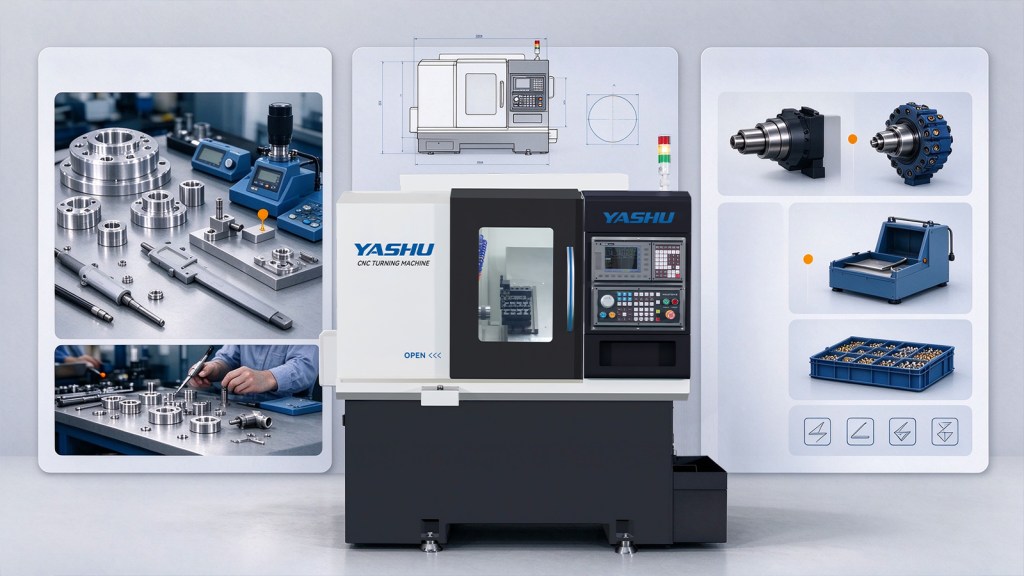
Compact CNC turning has earned a permanent place on the floors of small manufacturers. A small CNC lathe converts bar stock into finished cylindrical parts with part-to-part repeatability that manual lathes cannot sustain across a production run, yet its footprint stays small enough for a corner of an existing machine shop. Choosing well is an engineering decision: swing, bar capacity, bed configuration, and tooling layout each bound what the machine can hold dimensionally, and shortcuts taken at purchase surface later as scrap, secondary operations, and tolerance failures. The sections below follow that order, closing with the buying and maintenance practices that protect accuracy over years of lathe work.
What Can a Small CNC Lathe Machine Produce for Small Parts?
The working envelope defines the class. Machines in this segment generally offer 200-320 mm swing over bed, 300-600 mm maximum turning length, and a spindle bore accepting 26-51 mm bar – enough to feed bushings, fittings, pins, and short shaft families as bar work.
Accuracy is where a rigid compact machine separates itself from light-duty hobby equipment. On 25 mm diameters, a leveled slant bed holds IT7 (0.021 mm) in production and IT6 (0.013 mm) on finishing passes with a fresh insert edge; concentricity between features cut in one chucking stays within 0.01 mm. Surface finish in the Ra 0.8-1.6 µm band is routine with coated carbide at constant surface speed. Free-cutting steels (12L14, 1215), brass, and aluminum run on modest spindle power; 304/316 stainless and titanium demand rigidity, sharp positive-rake inserts, and generous coolant to avoid work hardening. A machine for small parts is specified by its weakest link – an envelope that fits the part family, and a drive train that holds surface speed under load.

Which Industries Rely on CNC Turning for Small Production Runs?
Lot sizes of 50-500 pieces sit in the economic gap between manual engine lathes and transfer lines – exactly where compact CNC turning machines concentrate. Medical suppliers turn dental abutments and bone screws from titanium and cobalt-chrome; electronics plants cut connector pins and heat-sink bodies from brass and aluminum; automotive and aerospace sub-tier shops run fittings, sensor bosses, pins, and bushing families from 12L14. The shared requirement is changeover speed: program recall, preset tooling, and wear-offset correction let a small CNC machine switch part families between shifts in minutes, not hours. Work that outgrows manual turning migrates to CNC Turning Centers, where servo-driven axes hold dimensional consistency across repeated batches.
How to Choose the Right CNC Lathe Size for a Small Shop?
Three dimensions govern sizing, and none can be upgraded later. Swing over bed sets maximum workpiece diameter; turning length bounds shaft families; bar capacity caps what feeds automatically – a spindle bored for 26 mm bar will never pass 51 mm stock, so capacity should follow the largest planned part family plus margin.
Footprint planning extends beyond the machine outline. Benchtop and mini lathe platforms occupy roughly 1.5 × 0.8 m and run on 220 V single-phase power – a fit for small workshops in leased buildings. Production slant beds need 2.0-2.4 × 1.3-1.5 m of floor, a three-phase supply, and clearance for a bar feeder, chip conveyor access, and door swing. Mass matters as much as floor area: a 3-tonne cast-iron bed absorbs vibration that a 600 kg frame transmits into the cut – interrupted cuts succeed on the heavier machine, chatter appears on the lighter one. Machine mass, spindle power, and way design together set the achievable ceiling in demanding materials, not the control brochure.
What Types of CNC Lathes and Configurations Suit Small Businesses?
Configuration follows the part family, and the lathe options divide cleanly along that line.
Slant Bed vs. Flat Bed Compact CNC Lathes
A 30-60° slant bed lets chips fall from the cutting zone by gravity, keeping ways and turned surfaces clean, and brings the spindle to loading height. Flat-bed horizontal CNC lathe designs keep an edge in rigidity for heavy cuts and odd castings. Beds cast from HT300 Meehanite-class iron and stress-relieved by vibration aging hold geometry far longer than fabricated steel frames – the difference appears years later as taper on long shafts. Builders such as YASHU offer both layouts, including a versatile slant bed CNC lathe line with C-axis and live tooling for shops that mill and turn in one setup.
Turret Lathe vs. Gang Tooling
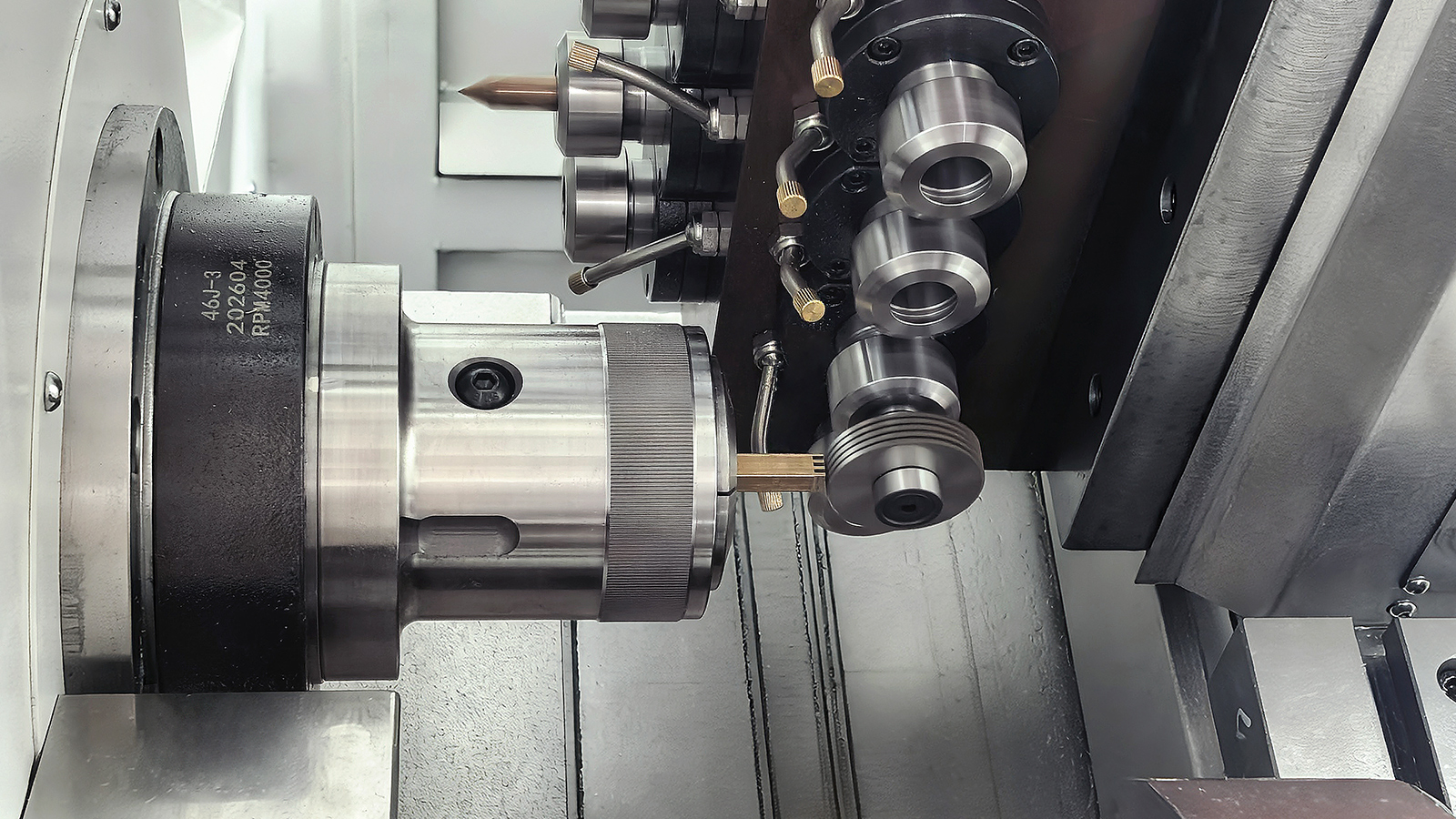
An 8-12 station turret lathe accepts turning, boring, drilling, and live tools with indexing of one to three seconds between cuts – the flexible choice when part families change weekly. Gang tooling mounts fixed tools on a cross slide: no index time, tool-to-tool moves under a second, ideal for high-volume bushings but limited in tool count and reach.
Live Tooling, C-Axis, and Mill-Turn Integration
A C-axis positioning the spindle in degrees, combined with live axial and radial tools, drills cross holes, mills flats and keyways, and cuts slots in the same setup as turning – work that otherwise queues a second visit to the CNC mill. Compact CNC Turning Centers equipped this way replace a two-machine cell for many small parts – one setup, one fixture, no queue at the milling machine.
Mini CNC Lathe and Entry-Level CNC Machines
A benchtop mini CNC lathe serves education, labs, and prototyping, but an entry-level CNC machine with a production-class control and a real turret scales into paid work as volume grows. For a first CNC purchase, control familiarity – G-code, simulation, local support – matters more than the last few millimeters of swing. The best CNC lathe for a beginner stays productive after the learning curve flattens.
What Should Buyers Consider When Buying a CNC Lathe?
Start from the part, not the price list. The tightest tolerance, the hardest material, and the daily part count eliminate most unsuitable machines before budget does. When comparing a CNC lathe for sale, request a test cut on the intended material at the intended tolerance – a vendor confident in the machine rarely declines.
CNC Lathe Machine Price and Total Cost of Ownership
The invoice covers only part of the investment. Chucks, collet sets, tool holders, a CAM seat, installation, and training add 25-40% to the base CNC lathe price in the first year. Cutting tools deserve their own line: a CNMG 120408 insert per ISO 1832 designation costs little per edge, but a cabinet of turning, boring, and live tooling adds up. An affordable CNC lathe without local service coverage frequently becomes the most expensive machine in the shop.
New vs. Used CNC Lathes
A used CNC machine trades lower entry cost for risk. Spindle hours, way wear, control generation, and spare-parts availability dominate the evaluation; a ballbar report and geometry checks per ISO 13041-1 – spindle runout, axis straightness, tailstock alignment – belong in the purchase contract. A small CNC lathe from a specialist builder such as YASHU arrives with those acceptance tests documented at the factory, plus warranty and training – which is why investing in a CNC machine new pays off when tolerances are contractual rather than aspirational.
How Do Maintenance Practices Protect Lathe Accuracy?
Daily practice decides whether quoted tolerances remain achievable in year five. Clear chips from way covers each shift, verify coolant concentration at 8-10% by refractometer, and warm the spindle 10-15 minutes before tight-tolerance work – thermal growth moves diameters measurably in the first hour. Monitor insert flank wear and correct through wear offsets rather than forcing worn edges through finishing passes. An annual geometry re-check per ISO 13041-1 turns slow drift into a scheduled correction instead of a scrap investigation.
FAQs
What swing and bar capacity does a typical compact CNC lathe offer?
Most offer 200-320 mm swing over bed, 26-51 mm bar capacity, and 300-600 mm turning length.
Can a compact lathe hold IT6 tolerance on stainless steel?
Yes, with conditions: rigid slant bed, sharp positive-rake inserts, flood coolant, constant surface speed on the finish pass, and a fresh edge after warm-up – the tolerance is achieved by the setup, not asserted by the brochure.
Is live tooling worth the cost on a small machine?
For parts with cross holes, flats, or keyways, yes. Live tooling removes a second setup and the queue at the milling machine; payback is measured in setups eliminated per month.
How much floor space and power does a small shop need?
Benchtop platforms run in about 1.2 m² on 220 V single phase; production slant beds need roughly 3-3.5 m² plus bar-feeder clearance and a three-phase supply. Confirming the power service before delivery makes a machine suitable for small workshops, not a return shipment.
What does total cost of ownership include beyond the machine price?
Workholding, tooling, a CAM seat, installation, training, and consumables – typically 25-40% on top of the base machine in the first year.
References
- International Organization for Standardization. (2010). Geometrical product specifications (GPS) – ISO code system for tolerances on linear sizes – Part 1: Basis of tolerances, deviations and fits (ISO 286-1:2010, 2nd ed.). https://www.iso.org/standard/45975.html – Source of the IT6/IT7 tolerance grades applied to turned diameters.
- International Organization for Standardization. (2017). Indexable inserts for cutting tools – Designation (ISO 1832:2017, 6th ed.). https://www.iso.org/standard/69202.html – Defines the insert designation system behind the CNMG 120408 example.
- International Organization for Standardization. (2021). Geometrical product specifications (GPS) – Surface texture: Profile – Part 1: Indication of surface texture (ISO 21920-1:2021, 1st ed.). https://www.iso.org/standard/72196.html – Governs the Ra surface-finish values quoted for turned surfaces.